I have been wanting to photograph Earthshine for a while. Earthshine is light from the sun that reflects off of the moon, then bounces off of Earth and back to the moon. So, it is very faint. If you have ever seen the unilluminated part of the lunar disk when the moon is in a partial phase, you have seen Earthshine.
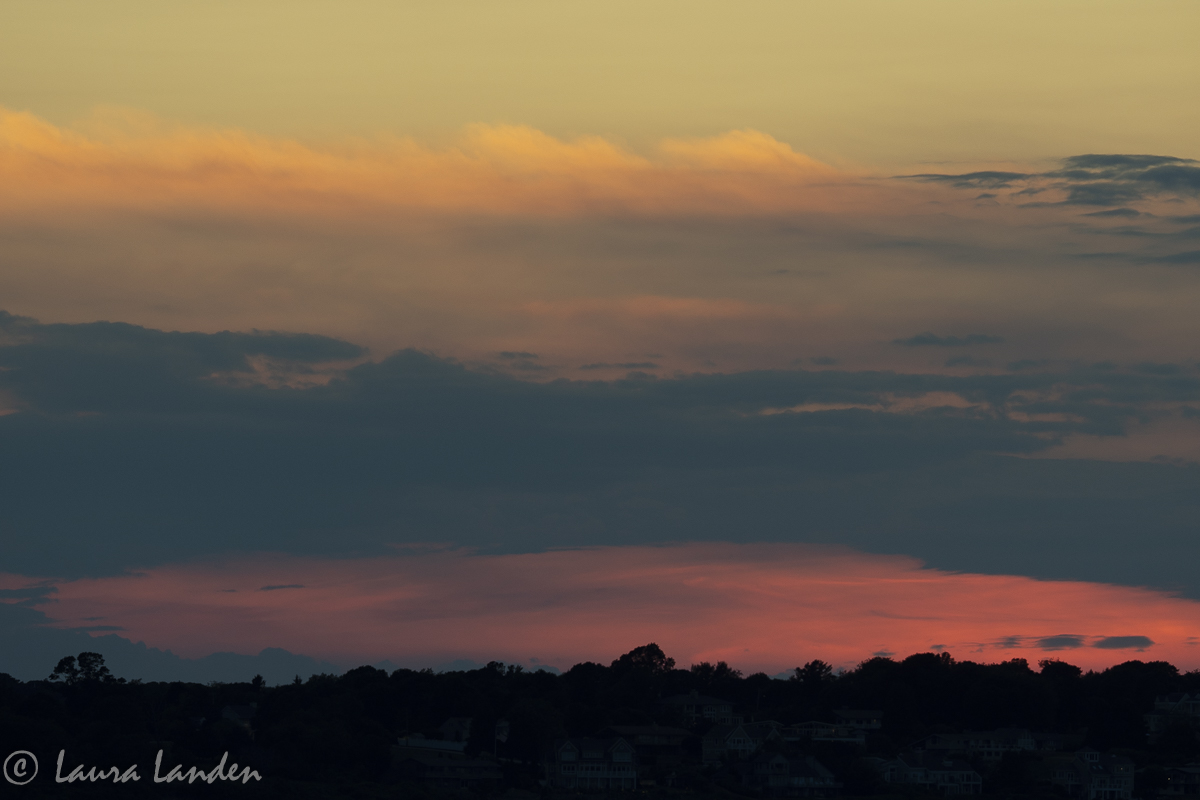
I tried in May to photograph Earthshine, with no success. I grossly underestimated how much I needed to reduce exposure to achieve a useful image. So, with the crescent moon waxing slightly since Sunday’s new moon, I thought I would try again. Last evening I went to Beavertail State Park and watched the sunset. Then I hung around, hoping that the clouds would part and the moon could break through, and I could get some useful images.
The best approach is to take two images, one exposed for the illuminated part of the moon, and the other exposed for the Earthshine. Then the hard part–combining them in Photoshop.
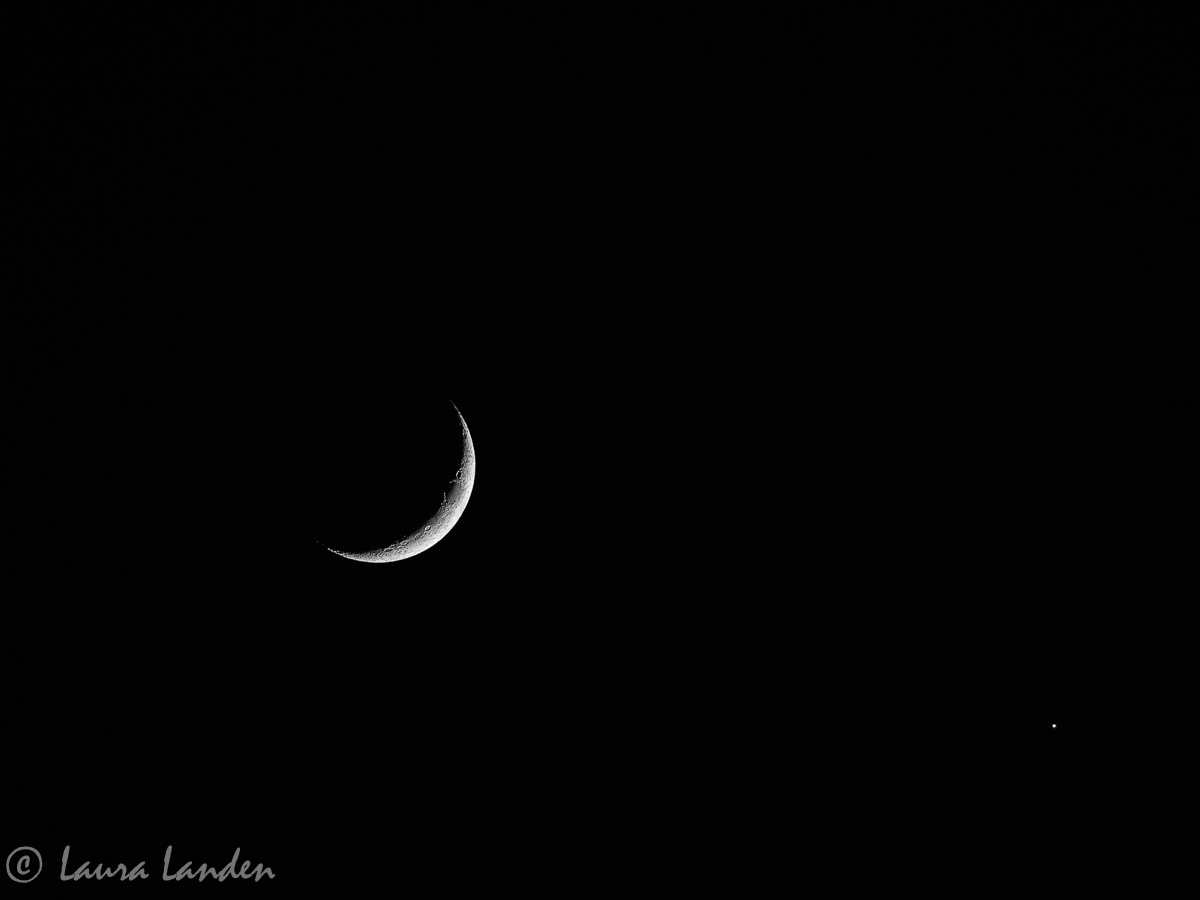
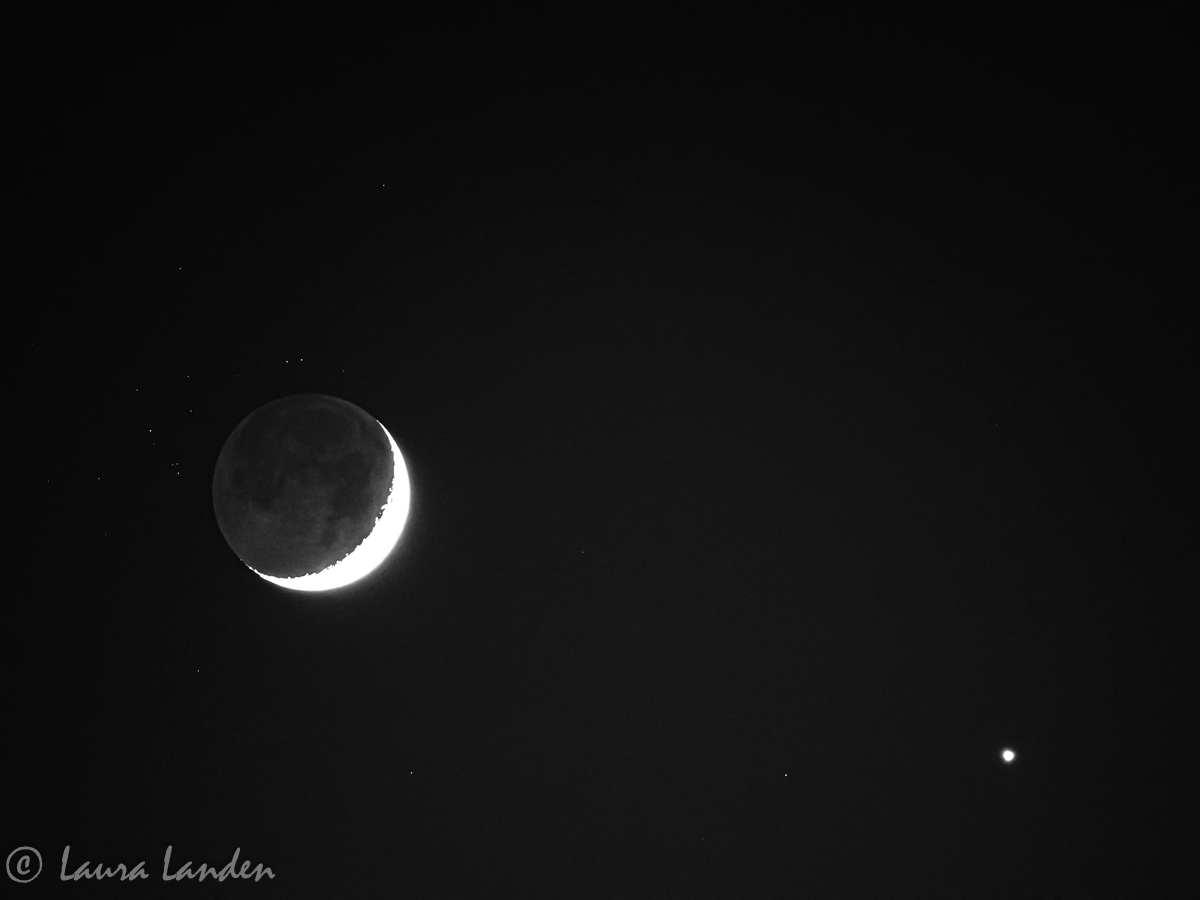
The moon was also close to some planets. Venus was closest, then Jupiter, and, closer to the horizon, Mercury. I was using a 300mm lens (600mm full frame equivalent), so I was only able to include Venus with the moon in the frame.
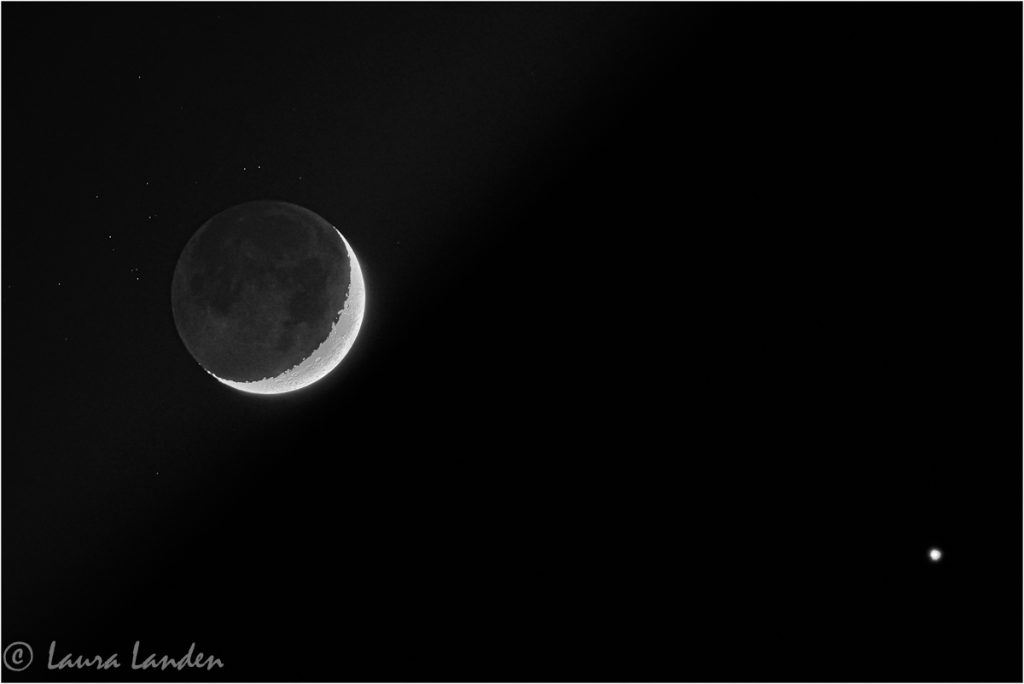
Combining the images in Photoshop involves importing them as layers, then aligning the two lunar disks. Next, applying a gradient on the crescent image (positioned on top) to blend the two together. It took me several tries at this, having never done this technique before. Here is the result. Don’t forget Venus in the lower right corner!
Fascinating, Laura. And I’ve added a new word/concept to my vocabulary. I thank you for “earthshine”.
What an amazing photograph, Laura! Love your posts, Laura! Love, Jan
Pretty Amazing, SD!!!! LOVE your posts!!!
Love, SD II ❤️❤️❤️
Thanks.
SD
Amazing, Laura!
Thanks, Vicky.
Will you be coming east this summer? I would love to see you.
Beautiful! I love seeing this when it happens. I have wondered how it could be photoshopped.
Thanks, Bernie.
I mostly followed Alyn Wallace’s procedure, except for the final step. This video is helpful.
https://alynwallacephotography.com/blog/2020/5/10/how-to-create-a-hdr-moon-photograph
Wallace died a couple of years ago at age 34. He had a rapidly spreading gall bladder stone infection that led to multiple organ failure. His death was a great loss to the astrophotography community.